THE EDGE Blog


Jan. 3, 2019

Four Strategies To Create And Engage A Motivated Real Estate Team

For new and experienced agents alike, it’s easy to get caught up in the hustle and bustle of the housing market, whether that’s by achieving your monthly goals or perhaps even falling short. If it’s the latter, it’s especially important to foster a positive, uplifting and inspiring company culture for your fellow agents.

Establishing an entrepreneurial environment driven by collaboration and innovation is just one of the many steps required for success and high performance in the real estate industry. Incorporating these four skills and motivational techniques into your daily routine and monthly/annual goals can help shape a team player into a real estate superstar.


1. Set S.M.A.R.T Goals

One of the most powerful tools in your arsenal is taking the time to set S.M.A.R.T goals. This means identifying specific, measurable, achievable, realistic and time-bound objectives. Our firm establishes goals like “generate 20% more listings in a specific region” or “increase new seller leads by 10%,” as opposed to the more general “generate more listings.” You can even add another layer to your goals by providing a deadline and tracking them on a monthly, quarterly or annual basis. This can help improve engagement and productivity and boost team morale. Additionally, agents who take accountability for hard-to-sell properties will often match those challenges with extra effort.

Be intentional and disciplined in your execution. Use your best judgment to determine how your team can set realistic goals and manage their expectations. By building concurrent personal and team goals, your firm can strike a balance that leads to overall business success.

2. Establish A Formula For Success

Develop an internal support system designed to enrich your business from within. Rather than relying on one person to get the job done, build a team of specialists with their own areas of expertise and strengths. One person may be an expert on mortgages, while another may know everything about the newest real estate technologies. Finding avenues to supplement, complement and leverage one another’s skills is a great way to build up a team environment that organically balances the firm.

We strive to provide an environment that surrounds agents with innovation, integrity and association among a group of talented and experienced real estate experts. Even the most successful agents need a team they can fall back on for support. From the top down, foster a family-like work environment.

3. Utilize Company Resources

Beyond your team, it’s equally important to explore the resources your firm has made available. Not sure what is offered? Ask! Opportunities like company training programs, online educational materials, professional development classes and mentorship programs are all great places to start. For example, we created a mastermind group to cultivate an ongoing dialogue between sales executives and provide a platform to learn from the most seasoned professionals while encouraging new voices to share fresh perspectives.

With the help of continuing education opportunities and comprehensive training resources, you will be equipped with the backing you need to confidently sell your next property. Use this arsenal to further refine your industry skills and enrich your team and business as a whole, especially during high-stress times.

4. Celebrate Wins

Rushing from one closing to the next can lead to burnout — we’ve all been there. From small successes to national award recognitions, take the time to celebrate growth on both an individual and firm level. This goes back to the value of setting S.M.A.R.T goals. Recognizing achievements creates a company culture that bolsters productivity while energizing recruitment efforts and maintaining retention. Enjoy the moments to stop and reflect on the achievements of your team, no matter how big or small.

The sky is the limit when it comes to victories in the real estate world. Taking the time to implement realistic and achievable goals, offer self-development opportunities and foster an encouraging environment will go a long way when boosting team performance and motivation.


By Dale Schaechterle, founding Partner and CEO at Metro Milwaukee-based Realty Executives IntegrityOriginally published in Forbes.com

Nov. 29, 2018

When Should I Refinance My Mortgage?

Refinancing your mortgage could be a smart financial move. It largely depends on timing.

But how do you know when the time is right for you to refinance?

First: Do you plan to own the home much longer?

Refinancing your loan doesn’t happen without a few fees. The good news is that most of these fees will simply be rolled into your new loan, so you won’t need to pay a lump sum out of pocket.

But if you’re planning to sell the home in a few years, you may not hold the mortgage long enough to recover these fees. Refinancing really only makes sense if you plan to own the home for the next several years.


Assuming that you plan to own the home for a while, refinancing your mortgage can save you a lot of money in the long-term. It could also lower your monthly payment. And it could even help you tap into your home equity to finance another project.

Here are three key times when you should strongly consider refinancing your mortgage.

1. When you can reduce your interest rate by 1% or more

If you’ve held your current mortgage since before the 2009 recession, your interest rate is probably much higher than today’s rates. And you’re probably paying way too much in interest.

Refinancing to get today’s lower interest rates could reduce your monthly payments and save you a fortune over the term of your loan.

Additionally, if your credit score has improved substantially since you applied for your current loan, you may qualify for a lower rate now than you could at that time.

Generally speaking, if you can reduce your interest rate by 1% or more, it is probably a good time to refinance. That 1% makes sure you’re saving enough money to recover the previously mentioned fees.

2. When it makes sense to change your ARM for a conventional mortgage

Interest rates are on the rise. If you currently have an ARM (Adjustable Rate Mortgage), your mortgage rate will be increasing as well.

To lock in today’s low rates, you can refinance to a traditional mortgage with a fixed rate. Fixed rates are often slightly higher than ARM rates, but they come with the assurance that your mortgage interest rate will not rise with the national interest rate increases.

If you currently have an ARM, seriously consider refinancing to a fixed rate mortgage before interest rates get much higher.

3. When you want to use your home equity

Do you have a fair amount of equity in your home? You may be able to use your home equity to finance other projects.

This is riskier than refinancing for a lower (or fixed) interest rate because this involves taking on additional debt, with your home as the collateral. But if you need funds for something like starting your own business or paying off high-interest debts, your equity could provide the funding you need.

Mortgage interest rates are on the rise, but they’re still low. If you can lower your interest rate, lock in a long-term low rate, or take advantage of your home equity, act quickly to refinance your mortgage before rates increase.

This post is intended for informational purposes only and should not be taken as professional advice. The point of view and opinions expressed in this post are those of the author and do not necessarily reflect the position of Realty Executives International. This post was written by Michelle Clardie. Michelle is a professional real estate blogger, specializing in ghostwriting Realtor® blogs. Her engaging content helps real estate agents become more visible online, generate more qualified leads, and increase their revenues. You can learn more at www.michelleclardie.com. 

Sept. 17, 2018

How Do You Know When It's Time To Sell Your House?

Is it time to sell your house? Or should you wait and see if home values continue to climb? Knowing when it’s time to sell your house can be tricky. But we have some tips to help. Here are the best indicators that it’s time to sell.

You’ve built equity in the house.

The most important factor in deciding when it’s time to sell your house is your home equity. How much money would you be able to keep from the sale of your house after you pay off any remaining mortgage loan and your closing costs?

If your sale price is high enough to break even on those costs, you’re clear to sell. But if you can keep enough money from the sale to put 20 percent down on your next house, you’re golden! That amount of equity is a great indicator that now is the time to sell your house.  

Your local market is hot.

Trying to time the market perfectly is a fool’s errand. But it’s certainly better to sell your house when your market’s hot. In a hot market, you have more buyers than listings. So the buyers compete for the limited housing inventory, which means higher home prices. That’s great news for sellers.

Thanks to low mortgage interest rates and a well-recovered national economy, there are hot markets all over the country. You local Realtors® can explain your current market conditions and provide insight as to how hot your local market is.  

You’re emotionally ready for the next phase of your life

Market conditions mean nothing if you’re not emotionally ready to sell.

Are you ready to move onto the next phase of your life? So ready that you’re willing to invest the time and effort in preparing the house for sale, scheduling your week around showings, working through the sales paperwork, and actually moving?

These short-term inconveniences lead to a reinvigorating fresh start. Are you ready to take that big step?

What about the season of the year?

Traditional wisdom is that spring and summer are the best time of year to list your house for sale. Buyers are looking to make a move while the kids are out of school, there are more hours of daylight to spend house-hunting, and the weather is conducive to touring properties, moving, and even tackling move-in renovations.

But if you’re in a geographic area that doesn’t experience all four seasons, time of year will have a much lower impact on your ability to find qualified buyers. You could even experience a surplus of buyers motivated to get settled in their new home before the holidays!

If you’re on the fence about selling, talk to a local Realtor®. They can explain local market trends to help you decide, with certainty, if now’s the time to sell your house.

This post is intended for informational purposes only and should not be taken as professional advice. The point of view and opinions expressed in this post are those of the author and do not necessarily reflect the position of Realty Executives International. This post was written by Michelle Clardie. Michelle is a professional real estate blogger, specializing in ghostwriting Realtor® blogs. Her engaging content helps real estate agents become more visible online, generate more qualified leads, and increase their revenues. You can learn more at www.michelleclardie.com

Posted in Listing Advice, Sellers
July 5, 2018

What To Consider If You're Planning To Move For Retirement

Usually, the only thing you’d think about when moving is location, location, location. However, when you’re moving for retirement, it’s never the same thing – you have to consider several factors because things will never be the same once you retire. For one, you won’t be earning the same money you usually earn from a regular day job. This means that when you retire, you should be keen on your expenses. Healthcare will also become a necessity during this phase of your life. To ensure that your move during retirement will become beneficial to you in the long run, consider these questions:

How much is your monthly budget?

This is probably one of the most important things to consider when you’re planning to move for retirement. For you to have a successful retirement, you should have an idea of how much are you willing to spend on it. You can budget for retirement by looking into your monthly expenses. Determine how much you’re spending for mortgage payments, car payments, and other recurring bills. You should also keep track of how much you are spending on leisure activities such as dining out, groceries and shopping. If you need assistance in doing all of these, you can use a mobile app (there are a handful of apps online) or hire a financial advisor. All of these can help you in your budgeting, especially if you don’t have any idea of how to do it. After considering your expenses, take note of all the possible sources of income every month. Once you have these numbers, it’ll be easy for you to come up with a monthly budget which is suitable for your needs and wants.

Where do you want to retire?

Aside from determining how much you can spend in a month, the location of where you want to retire should come next. Regardless if you’re moving somewhere new or near your current residence, you’ll be able to find a location appropriate for your needs and budget. You can narrow down your search by looking into locations which have recreational activities and volunteer opportunities for seniors. As a retiree, you should always have avenues for physical activities and have fun.

How far is your new location from friends and family?

Before saying “yes” to a broker who offered you a property somewhere, consider how near or far it is to your friends and family. People who retire would want to be near their loved ones so they can easily bond and spend time with them. If you’re currently living in the same town as friends and family, and you want to be near them once you retire, think about retiring in your current city. If not, scout for nearby locations which are within driving distance. You want everything should be accessible to you and to them. On the other side of the coin, if you want to live far from your friends and family (to finally have some time to yourself), move somewhere near an airport. This will make it easier for you to visit your friends and family, and for them to do the same too.

If you’re living far from your friends and family right now and want to move somewhere near them, take time to familiarize the area. You need to make sure that everything you can ever need is within the proximity. Doing this will also help you determine the amount of adjustment you’ll need to have once you move in.

Are there any healthcare facilities nearby?

When you age, your body starts to deteriorate. You’ll not be as energized as you were back when you were a teen. And with these changes, you’ll be needing a good doctor. Before moving, look for an area that has convenient healthcare facilities for you. Does this place have a hospital and credible doctor? Do they supply a wide variety of medications for your needs? Do they offer 24/7 medical assistance? You should have answers to these questions before deciding where to move. All of these are important for you to maintain your health once you retire. Aside from the availability of healthcare facilities, learn how your move can affect your healthcare plan. Usually, the healthcare plan you’ll enjoy will be dependent on where you move.

Are there recreational activities available?

Being physically active is a necessity for you to live a healthy lifestyle during retirement. For this reasons, your location should support recreational activities. It should allow retirees like you to enjoy an afternoon of playing tennis, swimming or hiking; it should not run out of activities for you to do. Some retirees would even choose their retirement destination based on the activities they love to do. Retirees who love outdoor sports may choose a retirement location which is near a beach or mountain. For retirees who have a green thumb, a location which has gardens or lawns are their best options. Think about the things which you can do in a location – these will keep you physically and mentally sharp as you age.

Do you have any existing debt?

The last thing you want to think during retirement is debt. Retirement should be the time for you to relax, and not stress out. This is why you should slowly pay all of your debts before retirement. Shell out money from your monthly income and allocate these for your debts. The earlier you clear your life from debt, the earlier you can start planning for your retirement.

Do you need help during the move?

After deciding where to move, think about “how” you can actually do it. If you’re planning to do everything DIY or with the help of your friends, pack everything ahead of time. Boxes should be labeled accordingly. Consider decluttering before the move so you won’t end up bringing items which you no longer use. You can also have a garage sale and use the money you’ll earn for your moving expenses. If you’re thinking of hiring professionals for the move, scout for moving companies and compare prices ahead of time. Make sure you’ll end up working with a moving company which can give you the service you want within a reasonable price.

Don’t Make Rash Decisions

If you have been working for decades, retirement may not come easy. This is a stage in your life that will require drastic changes. You’ll have to change your daily routines, let go of some relationships and even inject new activities just so you can live a healthier life. Fortunately, all of those changes can be pacified once you move in a location that is perfect for you. Deciding as to where that location is, can be might be a challenge but with the right sources, you’ll know what to do. Consider the tips from this article and you’re already a step closer in retiring to your new home.

May 29, 2018

6 Landscaping Renovations To Sell Your Home

Your home’s landscape and exterior space is the first thing that potential buyers notice. As they pull up to view your home, it is important that you are giving them a great first impression. These are a few great landscaping renovations that you can make to improve the chances of selling your home.

Power Wash Exterior Surfaces

A thorough, deep cleaning can go a long way in terms of improving the value and appeal of your home. Not only does power washing improve your home’s curb appeal, but it also can prevent mold from growing and keep your gutters in good working condition.

The National Association of REALTORS® estimates that power washing the exterior of your house can add between $10,000 and $15,000 to your home’s value, making it a great improvement choice. The most important exterior features to focus on include the siding, sidewalks, driveways, and any patios or decks.

Maintain Outdoor Greenery

Overgrown bushes and trees not only block the exterior of the house that you have worked so hard to improve, but they can also reduce outdoor views from the inside. Planting new trees can also appeal to homebuyers. Large trees tend to be low maintenance, yet they provide many home advantages including reduced energy bills, outdoor shade, and improved air quality.

Keeping your grass green and trimmed is another great practice for landscaping maintenance. It might be useful to consider the services of a local professional landscaping company while your home is active on the market.

Create an Outdoor Entertainment Space

Outdoor entertainment spaces can increase demand, thus increasing the resale value of your home. Even designing a small patio space with seating is a great “Do It Yourself” project that can increase your home’s appeal to potential buyers. There are outdoor space projects available for all budgets, with many housing trends using concrete and colored staining methods.

An outdoor entertainment space with shade or a screened covering is also likely to be a popular trend this year.  The National Association of Landscape Professionals lists climate cognizant landscaping, such as pergolas and retractable outdoor spaces as one of the top resale trends of 2018.

Clean Up Flower Beds

Bright and clean flower beds encourage people to feel at home. When people feel comfortable, they are better able to imagine themselves living there. When flower beds are messy and unmaintained, potential homeowners may be reminded how much work they will have to do upon moving in.

Freshen up the mulch, plant some brightly colored flowers, and remove any sprouting weeds. Colorful flower gardens are also expected to be a top 2018 landscaping trend. Even better are low maintenance flowers like Old Gold Junipers and black-eyed Susan’s. Sunfinity sunflowers are a popular choice as a brightly colored flower that is easy to maintain year-round.

Upgrade Irrigation

Upgrading a home’s irrigation system is often overlooked, but, may improve resale value. It is important to maintain and sustain your landscaping improvements. An upgraded irrigation system can help you do just that. Irrigation systems also get the most water efficiency, which can be a huge selling point saving buyers both money and time when it comes to yard maintenance.

Install Exterior Landscape Lighting

Landscape lighting illuminates the exterior of your home. It can improve curb appeal, functionality, and the safety of your home. Use your exterior landscape lighting to highlight the most important features of the home including the front door, windows, and walkways. Consider things like the light’s color temperature, effects, and wattages when choosing your exterior landscape lighting.

Your home’s landscaping affects its curb appeal. The first impression that you give potential buyers will influence their desire to purchase and the offer amount that they are willing to make. Upgrades that improve the landscape can increase your resale value and sell your home faster in the market.

This post is intended for informational purposes only and should not be taken as professional advice. The point of view and opinions expressed in this post are those of the author and do not necessarily reflect the position of Realty Executives International.

This post was written for Realty Executives by Heather Hardy. Heather is an avid writer who has contributed to numerous blogs and internet news sources.  While she writes on a variety of topics, her specialties include real estate, home improvement, and travel. After obtaining two degrees, Heather has found her passion in writing content that improves both readability and knowledge.

Dec. 13, 2017

Market Watch: Fed Again Raises Rates

For the third time in 2017, the Federal Reserve has modestly increased interest rates, showing its continued confidence in the U.S. economy.  Lawrence Yun, Chief Economist for the National Association of REALTORS, is predicting the 30-year fixed mortgage rate will continue to rise next year to an average of 4.5%.  Currently, rates are around 3.9%.  

What does this mean for you?  If rates rise to 4.5%, the monthly principal and interest (P&I) payment on a $150,000 mortgage loan will increase from $707 to $760.  Even at 4.5%, rates would still be on the very low side historically, making this year and next a great time to buy. 

Our team is Powered by Experts.  Call us today!  


Historical Mortgage Rates, 1972-2017


Posted in Real Estate Law
Aug. 25, 2017

Study: FSBOs Aren't Saving Money

In what is perhaps the "most robust test yet" with the "largest sample ever tested," financial analytics firm Collateral Analytics has concluded that For Sale By Owner (FSBO) transactions achieve sales prices significantly below those achieved by sellers who hire a REALTOR.  

To reach their conclusion, Collateral Analytics used data from normal housing markets (i.e., those not in rapid rise or decline) in 13 counties and 1,008 zip codes during 2016 and the first half of 2017, which accounted for more than 1.35 million sales.  

The factors that go into one's decision to sell by owner or hire a REALTOR vary across price ranges, geographical areas, and even age ranges.  However, using an automated valuation model (AVM), Collateral Analytics made great efforts to account for all of the factors that might sway a seller one way or another.

The results: Price per square foot is 5.02% to 7.26% lower for FSBO sales than REALTOR transactions sold through a Multiple Listing Service (MLS).  Even in the most detailed and comprehensive comparisons made by Collateral Analytics (tests run based on zip codes with confidence scores of 80% or greater), the average difference in the sale price for FSBOs was 5.526% less than those of MLS sales.  

A common argument against studies like this is that FSBO sales prices are always lower because FSBOs are assumed to be lower priced homes.  This is simply not the case.  In Collateral Analytics' study, the average sale of the FSBOs in the study was 15% higher than the average sale on the MLS sales.  Yet, when those same FSBO sales were compared to similar sales completed by REALTORS, the average result for all markets landed the FSBO seller 6% less on a price per square foot basis. 

Collateral Analytics concluded: "Using three different sorts of data and methodologies, we find that the differential in selling prices for FSBOs when compared to MLS sales is remarkably close to an average commission rate."  So, while FSBO sellers may be avoiding commissions, they are netting prices significantly less than they would with an agent.

The takeaway?  While full service real estate brokers are a transaction cost that can be avoided by selling by owner, new empirical evidence suggests that FSBO sellers avoid commissions to their detriment.  In addition, the study did not take into consideration the additional costs a FSBO seller has, such as lawyer fees associated with preparing a proper legal real estate contract (don't Google one, trust me...please!), potential legal exposure for lack of compliance with local, state, and federal disclosure laws, and time and energy expended "DIY'ing" the deal from start to finish.  

After this study, you have to ask yourself: why do all the work and bear all the risk when you can hire a professional and come out in the same financial position?

For more in-depth reading, see "Saving Real Estate Commissions at Any Price," Collateral Analytics Research (Aug. 16, 2017).

By Chris Cole


June 22, 2017

Hot Summer Market


Summer is officially here, and the housing market is warming up right along with temperatures.  Here are four great reasons to list your home for sale this summer:


  1. Buyers galore.  In our local market, buyer activity is strong.  The same is the case in markets across the U.S., according to the latest REALTORS® Confidence Index Survey compiled by the National Association of REALTORS®.  Our Executives are working with a large number of buyers who a ready to buy right now, but can't find what they're looking for.  More and more often, buyers are competing with each other for the same properties.  Why not take advantage of strong buyer activity?  
  2. Inventory (not) galore.  A normal, well-functioning housing market requires a 6-month supply of inventory. In our local market, many price ranges have 4 and 5 months of inventory.  This combined with heavy buyer demand leaves us with a shortage of homes available to satisfy the needs of buyers.  Basic economics tells us that when demand is high and supply is low, prices tend to go up.  But hurry, smart builders have started to fill this void, and better than existing homes do, so your competition is only going to get more fierce in the near future.
  3. Quicker closings now, longer later?  Fannie Mae is predicting a surge in home sales through 2017 and into 2018.  We believe banks and other mortgage originators will be slow to react to increased loan applications, processing, and underwriting needs.  Selling now could be a much less stressful and quicker transaction.
  4. Great time to move up.  If you find a new home that suits you, now is a great time to move up.  As mentioned above, supply and demand will cause prices to appreciate by up to 4.8% through 2018, according to CoreLogic, a real estate data, analytics, and technology company.  And while interest rates have trended slightly upward in 2017, the current 30-year fixed rate continues to hover around 4%, a mere 75 basis points above the record low.  However, rates are predicted to continue to move up over the next year.

As you can see, market conditions are great for both buying and selling.  Contact one of our Executives to get started!

Posted by Chris Cole

Jan. 9, 2017

Federal Housing Administraction (FHA) Reduces Annual Premiums

The U.S. Department of Housing and Urban Development (HUD) announced today that the Federal Housing Administration (FHA) will reduce the annual premium that most borrowers pay on FHA loans by 25 basis points, or 0.25%.  

Like Fannie Mae and Freddie Mac, FHA doesn't make loans, but rather provides a safety net for lenders.  The fee charged on an FHA loan is a "mortgage insurance premium" FHA takes in exchange for insuring the percentage of the loan above 80%.  The premiums fund FHA's Mutual Mortgage Insurance Fund, which helps FHA protect against losses incurred if borrowers run into financial troubles.

"After four straight years of growth and with sufficient reserves on hand to meet future claims, it's time for FHA to pass along some modest savings to working families," HUD Secretary Julian Castro said. 

The new premium schedule applies to loans with an insurance endorsement date of January 27, 2017 or later.  This change is expected to save the average home buyer $500 per year in insurance costs.  

UPDATE 1/21/2017: The Trump administration has suspended the premium cut indefinitely.  While many REALTOR groups praised the cut as a means to help more borrowers access FHA loans, other industry groups viewed the cut as too small to mean big savings for borrowers (FHA estimated the cut would save borrowers an average of $500 per year). Industry economists have cautioned that is it wise to examine any last-minute decisions by previous administrations that could be motivated by politics.  In addition, it is worth noting that FHA took a taxpayer funded bailout in 2013 because its reserves were not sufficient to meet its obligations to banks on defaulting loans.  At least with respect to FHA reserves, it appears the President is choosing to err on the side of caution.


Dec. 16, 2016

Fed Hikes Rates, Mortgage Rates Climb


The Federal Reserve raised the short-term interest rates on Wednesday for the second time in a decade and signaled that rates could continue to rise into 2017.  What does this mean for mortgage rates and your buying power?

First of all, it's important to recognize that mortgage rates are not set by the Federal Reserve.  The Fed sets the short-term benchmark interest rates, which are different from long-term interest rates applicable to mortgage loans.  Mortgage rates typically follow the long-term bond rates, such those tied to the 10-year Treasury note.  Long-term rates typically adjust before the Fed makes an adjustment.  For example, mortgage rates have risen almost 60 basis points, or 0.60%, since the presidential election, a figure more than twice that of the Fed's 0.25% hike on Wednesday.

Importantly, the Fed signaled that it expects to raise short-term rates three times next year by a total of 75 basis points, or 0.75%.  This means that mortgage rates will likely move higher before the Fed acts again.  Economists predict that if the Fed carries out the three planned rate increases in 2017, mortgage loan rates could come close to 5% on 30-year fixed notes.  Currently, Freddie Mac is reporting that 30-year fixed rates are averaging around 4.16%.

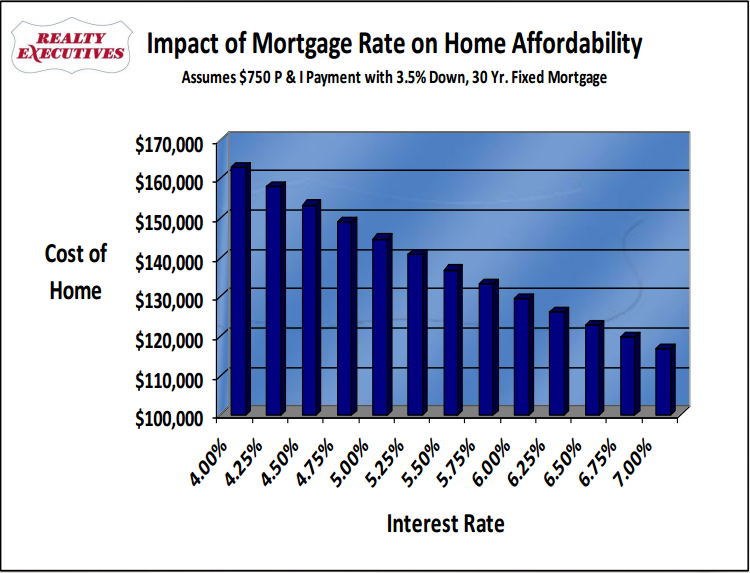
How does a rate hike affect your buying power?  Take a look at this chart.  As you can see, even slight increases in mortgage loan rates can have a big impact on your buying power. 

If you're planning on buying this year, doing so sooner could have a big impact on what you can buy.  Call us today!